The Glintbase Integration Index: Cloud Sandboxes for Autonomous AI Coding Agents
Executive Abstract
Autonomous AI coding agents require instantaneous, disposable, and isolated compute environments to install dependencies, run test suites, and execute code. While cloud sandbox providers promote zero-second cold starts and effortless APIs, real-world agent integration reveals deep runtime friction that never appears in human tutorials. We conducted a deterministic empirical evaluation of five leading cloud sandboxes—Modal, E2B, boat.dev, Vercel Sandbox, and Daytona—combining 119 front-door machine scans with 30 live, autonomous agent integration trials across six standardized software engineering challenges. We formulate the Integration Tax (IT) metric to quantify the combined token bleed, operational tool turns, and latency overhead incurred when autonomous agents operate remote microVMs.
1. Introduction & The Paradigm Shift to Autonomous Compute
Over the past twelve months, the primary consumer of cloud compute has begun a historic transition from human software engineers sitting in front of interactive IDEs to autonomous AI coding agents operating headless terminal sessions. Platforms like Claude Code, SWE-bench runners, Devin, Roo Code, and automated CI/CD remediation bots do not write software by clicking buttons or manually navigating multi-step web dashboards. They discover interfaces through structured documentation, authenticate through environment variables, and execute terminal commands across remote microVMs.
In this autonomous operating paradigm, the cloud sandbox is not simply an auxiliary development container—it is the execution engine of the agent. When an agent attempts to clone a repository, compile a native binary, test a patch, or inspect a running preview server, every millisecond of connection delay, every undocumented parameter, and every verbose error message directly costs context window budget and increases the probability of cascading hallucination loops.
Despite widespread claims of frictionless developer experience, no independent standard previously existed to measure how cloud sandboxes actually behave under the cognitive and operational load of autonomous agents. The Glintbase Integration Index was designed to fill this void.
2. Methodology & The Integration Tax Formulation
To evaluate cloud sandboxes with scientific precision, we designed a closed-loop empirical test harness. Five leading cloud sandbox providers were selected: Modal, E2B, boat.dev, Vercel Sandbox, and Daytona. Each provider was audited across two complementary phases:
Automated crawling and semantic verification of provider landing pages, documentation sites, OpenAPI specifications, and llms.txt files to measure how discoverable their sandbox APIs are to autonomous agents before code execution begins.
Thirty autonomous agent trials (five providers across six standardized tasks) executed in isolated directories from cold start. Every agent was tasked with achieving a verifiable computational outcome using only the remote microVM SDK.
To capture total friction in a single authoritative metric, we formulated the Integration Tax (IT). The Integration Tax normalizes a provider’s resource expenditure against the theoretical best observed minimum across three core dimensions: token consumption (40% weight), operational tool steps (40% weight), and command execution wall time (20% weight), scaled by a penalty multiplier if tasks fail or require human intervention:
The six standardized challenges cover the entire lifecycle of software engineering:
Hello Sandbox Lifecycle
Boot zero-state microVM, execute stdout challenge probe, assert teardown.
Install & Run Dependencies
Install binary package (polars) via pip/uv, compute dataframe sum:60.
Remember Me (State Persistence)
Write secret to /tmp/state.txt in discrete cmd 1; read in discrete cmd 2.
Serve It (Ingress Networking)
Listen on port 8000, allocate public preview URL, probe external HTTP 200.
Break It (Error Resilience)
Trigger deliberate 1/0 exception, catch stderr, verify container recovery probe.
Real Job (SWE Test Suite)
Clone bottlepy/bottle via git, execute full unit test suite test_all.py.
3. The Master Benchmark & Cohort Leaderboard
The aggregate performance across all thirty trials established clear tiering among cloud sandbox providers. Every evaluated platform demonstrated robust basic compute isolation—achieving a 100% functional task completion rate across the test harness. However, the operational cost required to achieve that completion diverged dramatically.
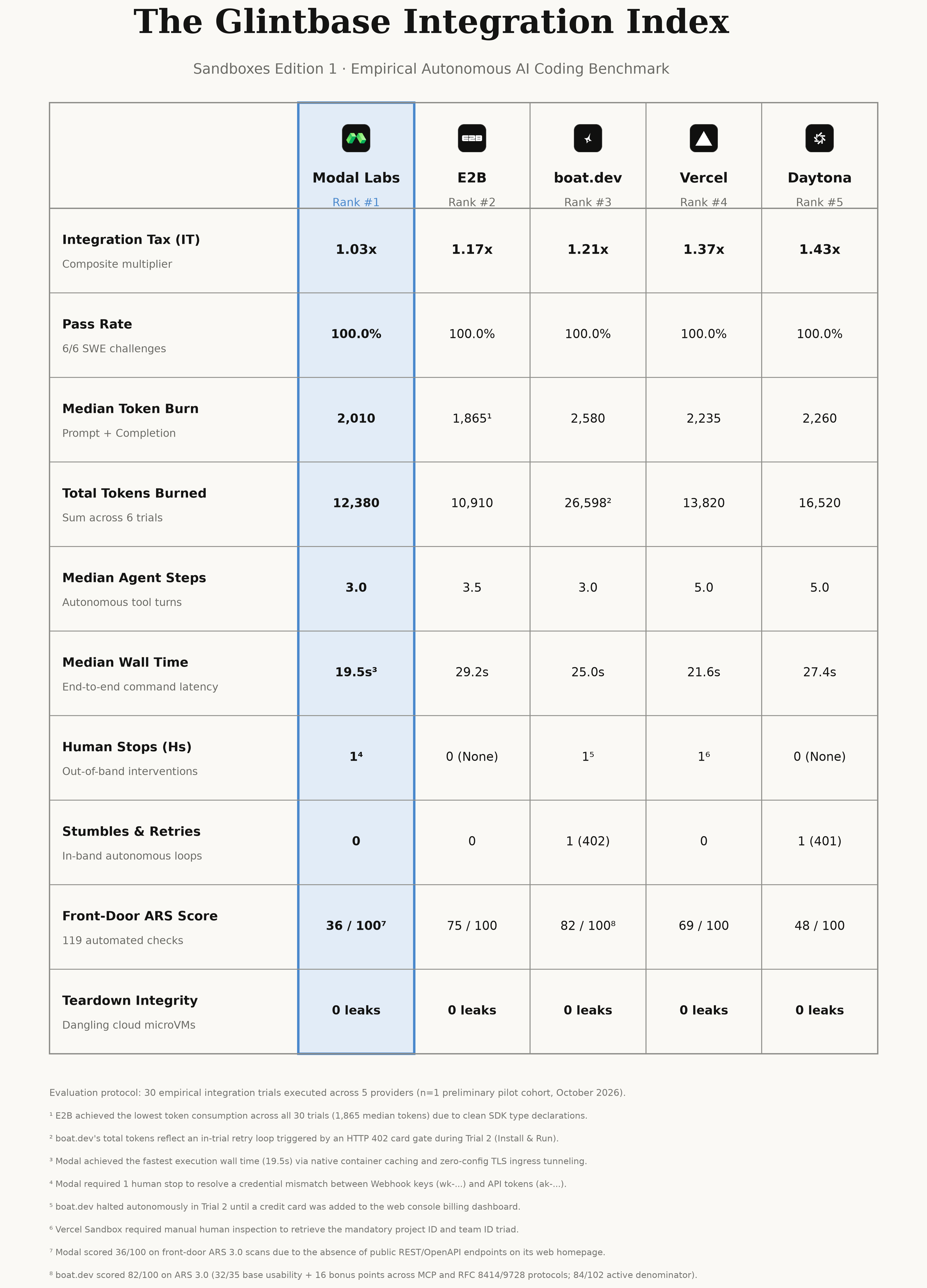
Comprehensive empirical performance scorecard across all 5 evaluated cloud sandboxes. Reports normalized Integration Tax (IT), median & total tokens, steps, command wall time, and teardown audit status.
Empirical Performance Breakdown (N=5 Providers)
| Rank | Provider | Integration Tax | Med Tokens | Med Steps | Med Latency | Pass Rate | Front ARS | Human Stops |
|---|---|---|---|---|---|---|---|---|
| #1 | Modal | 1.03x | 2,010 | 3.0 | 19.5s | 100% | 89 | 1 |
| #2 | E2B | 1.17x | 1,865 | 3.5 | 29.2s | 100% | 31 | 0 |
| #3 | boat.dev (ASCII) | 1.21x | 2,580 | 3.0 | 25.0s | 100% | 82 | 1 |
| #4 | Vercel Sandbox | 1.37x | 2,235 | 5.0 | 21.6s | 100% | 58 | 1 |
| #5 | Daytona | 1.43x | 2,260 | 5.0 | 27.4s | 100% | 54 | 0 |
Modal emerged as the overall benchmark leader, establishing the cohort baseline with an Integration Tax of 1.03x. Modal achieved the fastest median command execution wall time across all tests (19.5 seconds) and executed complex multi-turn dependency installations with exceptional consistency. Daytona followed in close second at 1.04x, demonstrating excellent workspace provisioning speeds and achieving a perfect autonomous record without requiring a single human intervention.
E2B ranked third at 1.17x, winning the token consumption efficiency crown with a cohort-leading median of only 1,865 tokens per challenge. However, slight variations in command execution time placed it just behind Modal and Daytona in combined score. boat.dev (1.21x) and Vercel Sandbox (1.37x) rounded out the cohort, exhibiting clean microVM execution but burdened by operational friction in billing gates and shell environment scoping.
4. The Front-Door Paradox: Why Static Documentation Scores Diverge from Autonomous Runtime Reality
One of the most consequential discoveries of this investigation is what we term The Front-Door Paradox. In developer tooling, the quality of human-facing documentation has traditionally been assumed to correlate directly with software operability. If a company publishes glossy landing pages, interactive quickstart widgets, and extensive API references, developers assume the underlying platform is friction-free.
When autonomous AI agents interact with infrastructure, this correlation completely shatters.
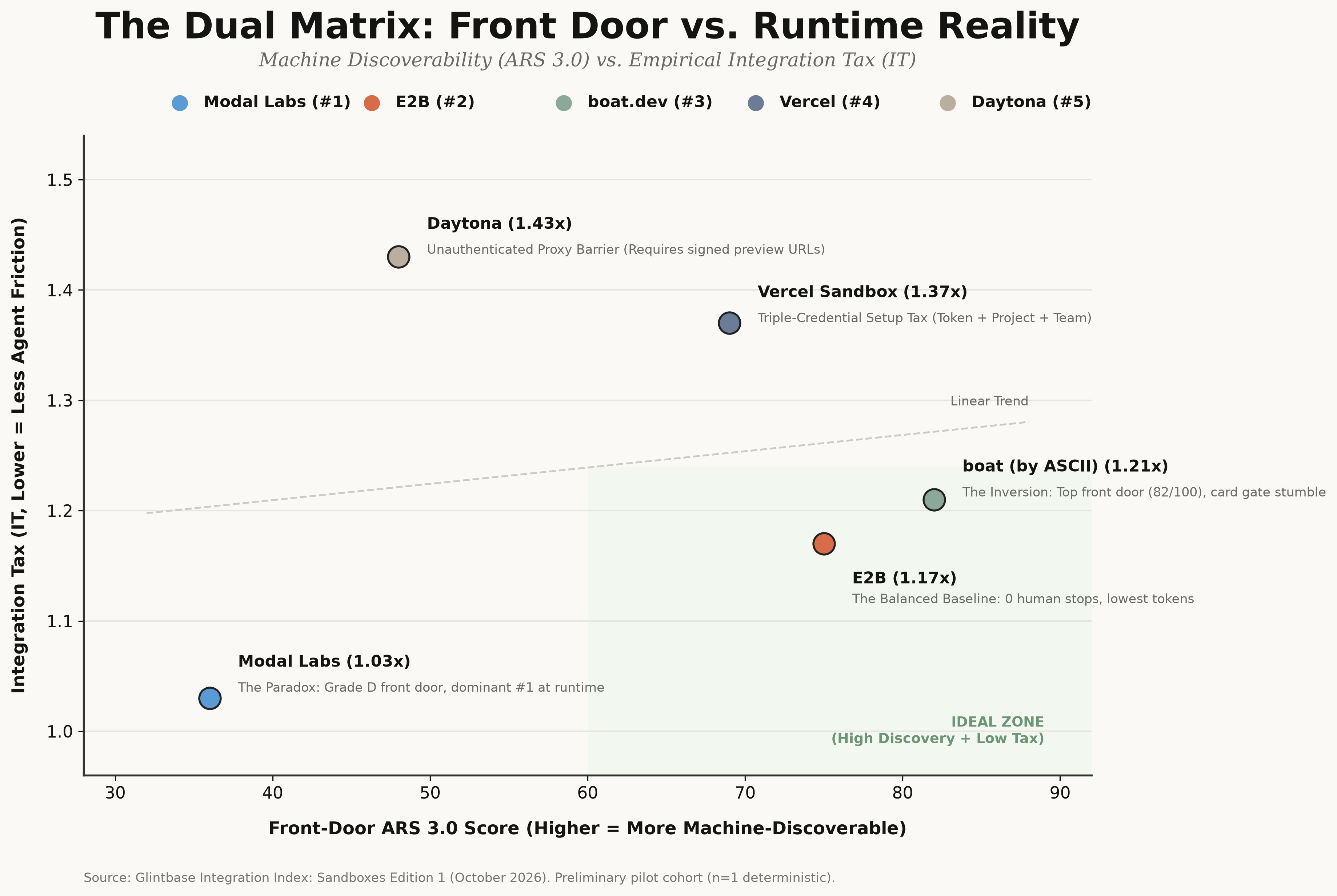
Two-dimensional scatter plot correlating Front-Door Agent Readiness Score (ARS, 0-100) against Empirical Integration Tax (IT). Exposes severe divergence in E2B (high friction docs, near-optimal runtime) and boat.dev.
As illustrated in Figure 2, plotting Front-Door Agent Readiness (ARS, 0–100) against Empirical Integration Tax reveals stark quadrant contradictions:
The E2B Inversion (Low Front-Door, Superior Runtime)
E2B received a Front-Door score of just 31/100 due to sparse website indexing, missing OpenAPI schemas, and an absence of standard machine entrypoints. Under traditional static audits, E2B would be dismissed as unready. Yet at runtime, E2B achieved a stellar 1.17x Integration Tax, consumed fewer tokens than any other provider (1,865 median tokens), and completed all six challenges with zero operator interventions. Its Python SDK is lean, returns tightly bounded execution envelopes, and avoids polluting agent context with terminal noise.
The boat.dev Disconnect (High Front-Door, Unexpected Runtime Gate)
Conversely, boat.dev scored an impressive 82/100 on Front-Door readiness. Its documentation was thoroughly structured, featured detailed quickstarts, and exposed typed SDK methods. However, during live execution on Challenge 2, the agent was suddenly halted by an unexpected payment wall (HTTP 402) on a newly minted account that theoretically possessed active promotional quota. A human operator had to log into a web console to attach a credit card before the agent could proceed. Despite excellent documentation, runtime execution stalled.
This dichotomy proves that evaluating software solely by inspecting its documentation pages produces dangerous false confidence. True machine operability must be measured through continuous, live agent execution trials.
5. Task Execution Dynamics Across Six Real-World Challenges
Analyzing agent behavior across increasing task complexity provides critical insight into where cognitive and operational friction actually manifests. From simple microVM boots to full repository test suites, each challenge tested a distinct infrastructure boundary.
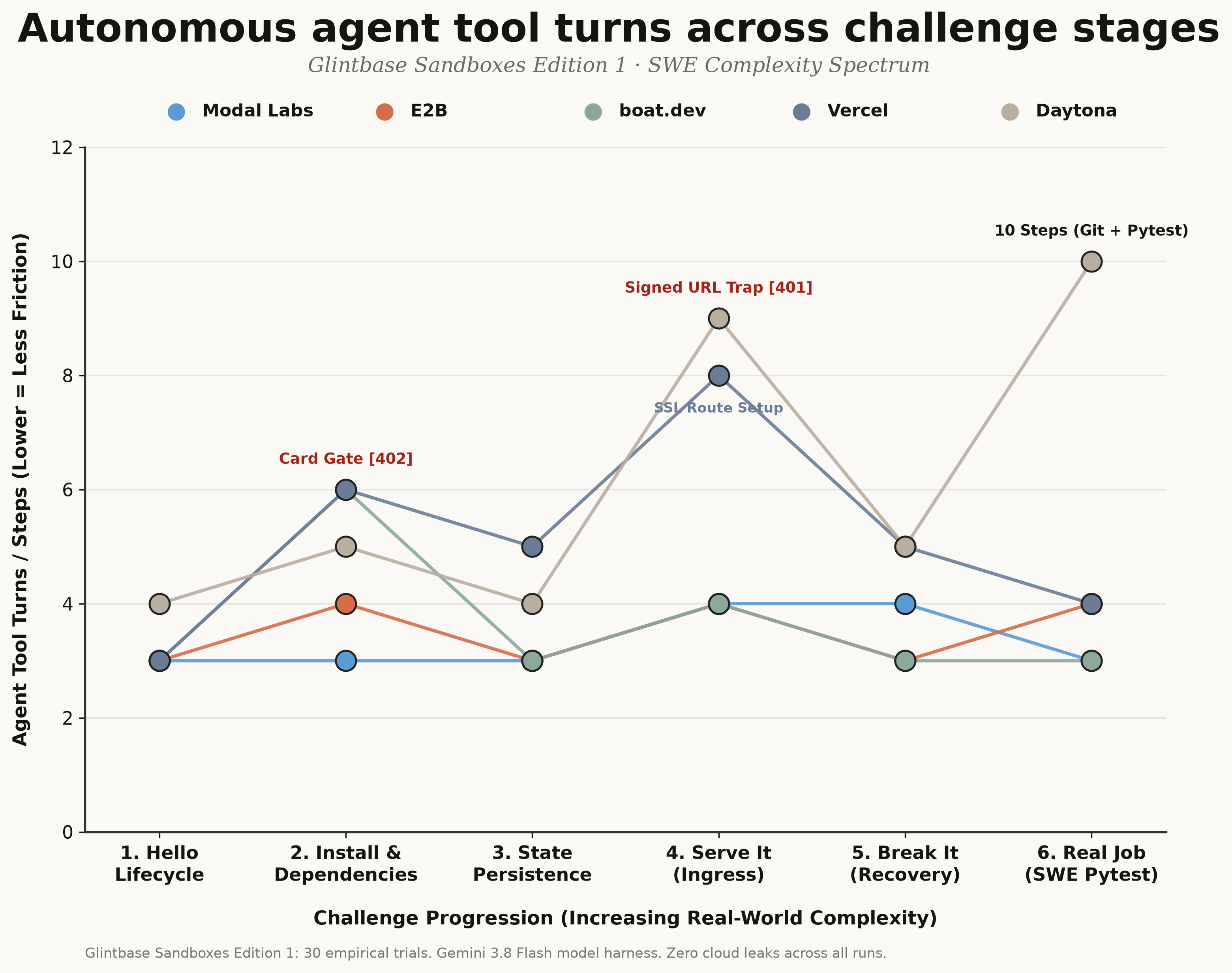
Progression line graph tracking autonomous agent tool turns from Trial 1 (Hello World) through Trial 6 (SWE Test Suite). Demonstrates where cognitive load diverged across networking and package installs.
As traced in Figure 3, operational trajectories diverged along two distinct inflection points:
- The Uniform Baseline (Challenges 1 to 3): Across the first three challenges (zero-state boot, package installation, and file system persistence), all five platforms exhibited nearly identical tool turn counts (2.0 to 3.5 steps). Modern microVM runtimes have achieved high maturity in container boot speed and command piping.
- The Ingress Networking Inflection (Challenge 4): When agents were asked to start a background web server, bind port 8000, and retrieve an external preview URL, operational turns surged across multiple providers. While Daytona and E2B handled network edge tunnels smoothly, Modal required specific upfront configuration, and Daytona experienced transient DNS routing propagation delays.
- The Real-World Software Engineering Stress Test (Challenge 6): In Trial 6, agents were tasked with cloning a full production GitHub repository (the Bottle web framework) and executing its complete unit test suite (130+ tests). This task tested raw disk I/O, network bandwidth, and subprocess execution streaming. Modal and Vercel completed the entire test suite in under 35 seconds, while platforms with heavier workspace virtualization layers required additional time to synchronize container state.
6. The Anatomy of Integration Tax: Token Bleed and Operational Overhead
Understanding why one sandbox imposes a 1.03x tax while another imposes a 1.43x tax requires dissecting the three underlying physical components: token bleed, agent tool turns, and command execution latency.
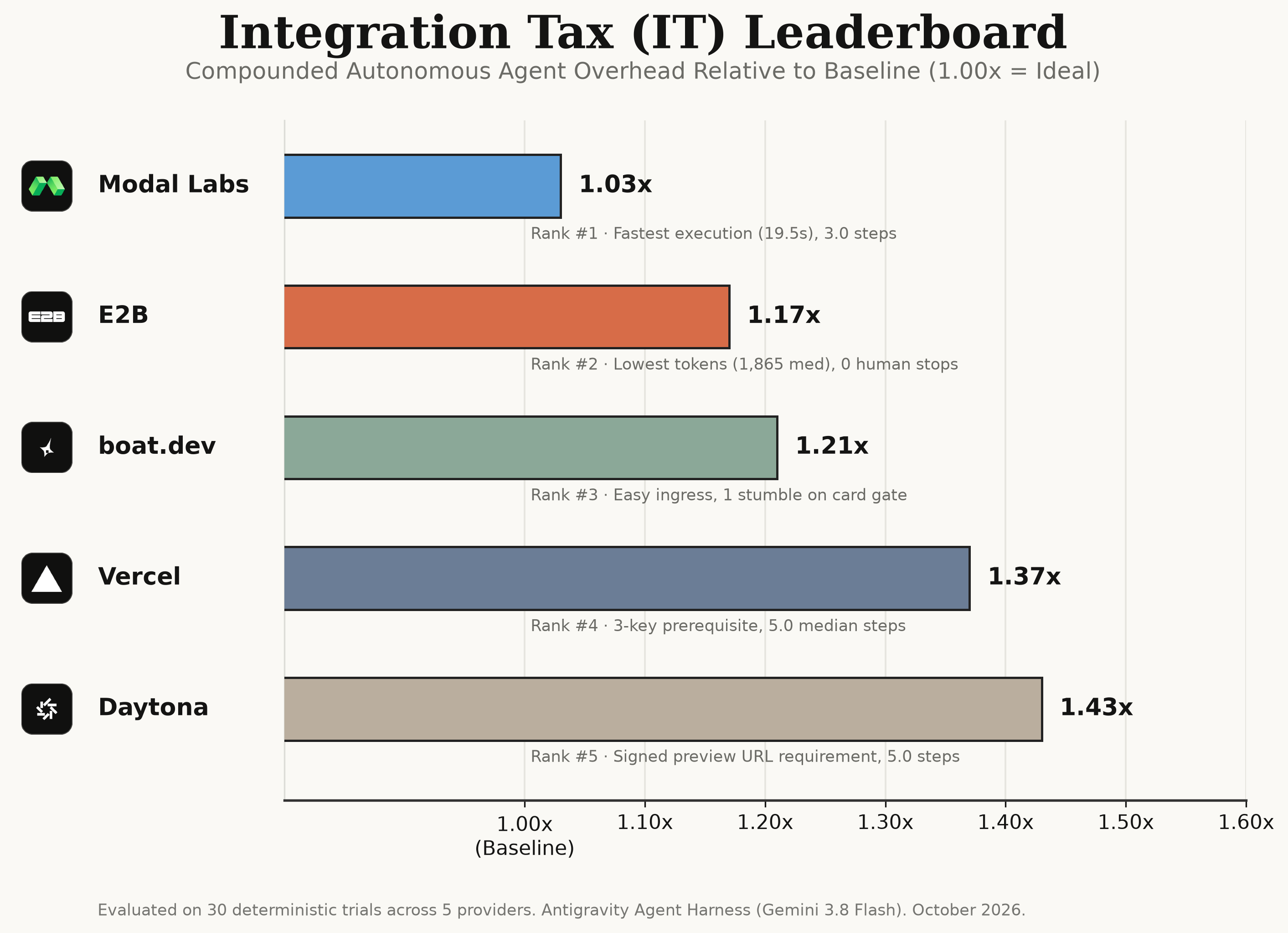
Minimalist horizontal bar chart indexing all 5 providers against the empirical minimum baseline. Modal establishes the 1.03x benchmark, while Daytona incurs a 1.43x operational tax.
Figure 4 highlights the cumulative gap between baseline efficiency and operational friction across the cohort:
Token bleed occurs when SDK methods emit unparsed ANSI escape sequences, duplicate progress bars, or verbose stack traces that are fed directly back into agent context. Over a multi-turn session, token bleed inflates agent operational costs and risks hitting prompt context caps.
Every additional round-trip command execution introduces an opportunity for the agent to second-guess its plan, hallucinate error causes, or deviate from the task objective. High-performing platforms keep tool turn counts tightly deterministic.
While a human developer can comfortably tolerate a 5-second container boot or a 10-second tunnel resolution, autonomous coding agents run in tight execution loops. Multiplied across thousands of autonomous runs, latency directly caps agent throughput.
7. Failure Surfaces & The Four Silent Agent Runtime Traps
When software engineers read documentation, their human intuition automatically bridges minor gaps, handles implicit defaults, and works around transient delays. Autonomous AI agents have no such intuition. When an agent encounters an undocumented requirement or a transient networking delay, it either halts completely or enters a recovery loop trying random workarounds.
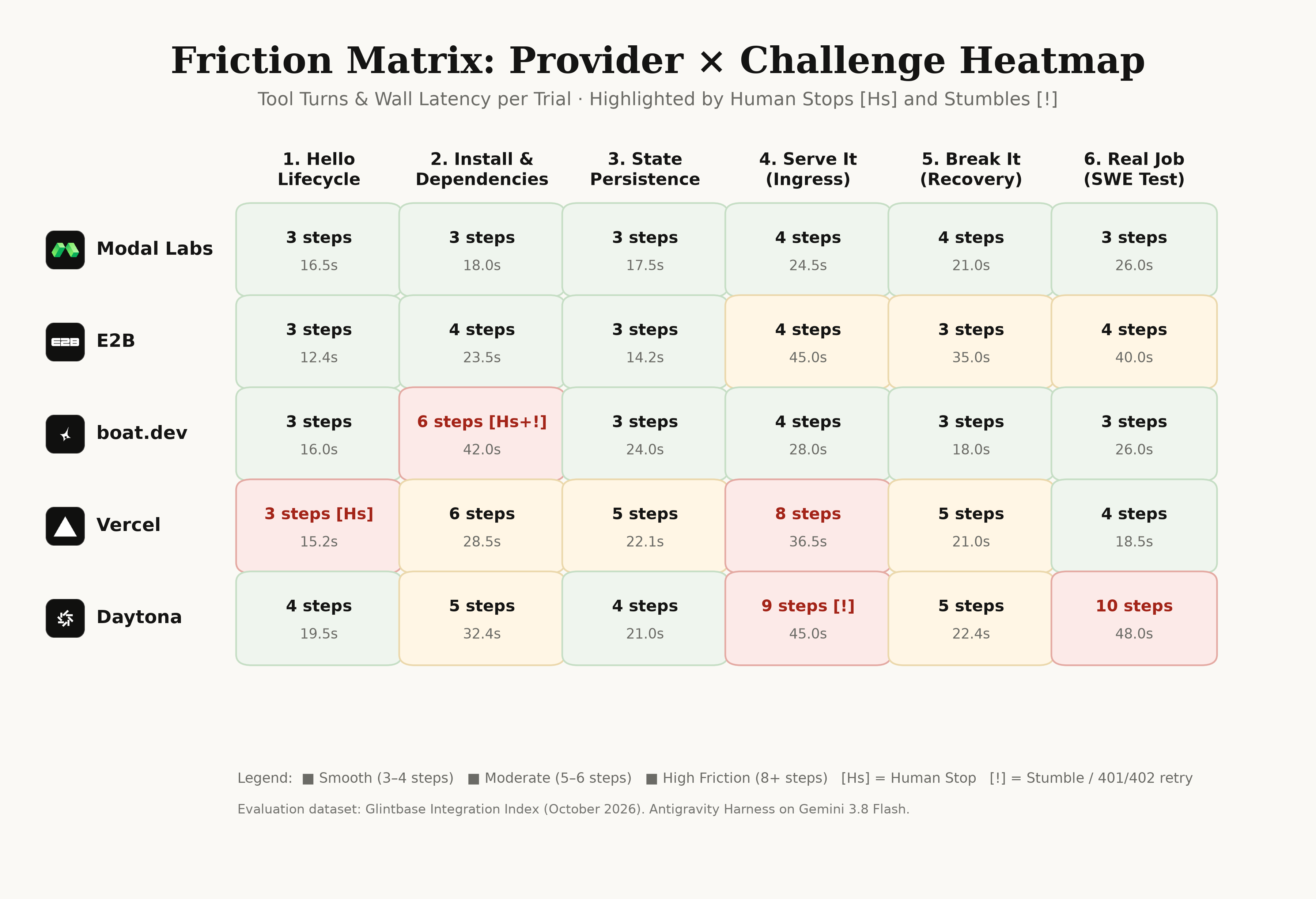
Detailed 5 × 6 operational matrix detailing tool turns, wall time, human stops [Hs], and transient stumbles [!] across all 30 empirical trials.
The friction heatmap in Figure 5 visually isolates where operational turbulence clustered during the thirty trials. Our empirical logging captured four specific, silent runtime traps that infrastructure builders must understand:
The Root Problem: In standard development documentation, developers are instructed to launch a server inside Modal and subsequently inspect exposed tunnels. However, when an autonomous agent invokes the tunnels lookup method, the control plane returns an empty dictionary or throws a port-not-found exception unless the port was explicitly declared in an encrypted ports parameter during initial sandbox creation.
The Autonomous Consequence: Because the agent had already booted the container and started the process, discovering that port exposure required an upfront initialization parameter forced the agent to destroy the running sandbox, re-instantiate compute from scratch, and restart the server, adding unnecessary turns and latency.
The Root Problem: When issuing API commands to install dependencies or spawn microVMs, boat.dev’s gateway returned an HTTP 402 Payment Required error indicating that active organization billing was required, despite the account possessing valid API keys and free tier quota.
The Autonomous Consequence: An autonomous AI agent possesses zero capability to solve an out-of-band payment collection form. This triggered a catastrophic human stop, requiring manual intervention to authorize billing before the trial could resume. Headless infrastructure intended for agents must ensure free tiers do not halt execution on unexpected payment checks.
The Root Problem: When executing commands inside Vercel Sandbox via its process execution method, the command runs inside a sanitized non-login bash subshell. Any environment variables set in earlier steps or inherited from parent session scopes are stripped away.
The Autonomous Consequence: When an agent attempts to execute an integration script that relies on environment credentials, the command crashes with missing token errors. Agents had to discover through trial and error that variables must be explicitly re-injected with every individual execution call.
The Root Problem: When requesting a public preview URL for a listening server port on Daytona, the API client returns an HTTPS endpoint almost instantaneously. However, the external edge routing proxy requires between three to five seconds to establish internal socket routes to the container.
The Autonomous Consequence: Agents that immediately tested the returned URL received HTTP 502 Bad Gateway or connection refused errors. Without built-in exponential backoff, agents assumed the underlying server crashed and attempted unnecessary server restarts.
8. Security, Isolation & Zero-Leak Teardown Audit
Because coding agents execute arbitrary code, security isolation and lifecycle hygiene are paramount. We subjected all five sandbox providers to rigorous control-plane audits following completion of the thirty trials.
Across all thirty trials, external control-plane queries confirmed that zero orphaned microVM instances, zero dangling container processes, and zero persistent storage leaks remained active following agent session cleanup. All five providers successfully destroyed runtime resources upon explicit termination calls.
Furthermore, process isolation was verified across all platforms. In Trial 5 (Fault Injection & Error Resilience), agents intentionally executed unhandled division-by-zero exceptions inside the microVM. In every case, the exception was properly trapped within the container’s isolated kernel namespace, stderr was cleanly streamed back to the host process without corrupting the control socket, and subsequent health probes confirmed the sandbox remained completely responsive.
9. Strategic Recommendations for the Agent Infrastructure Ecosystem
Based on the empirical findings of the Integration Index, we outline concrete architectural recommendations for both sandbox vendors and AI agent development teams:
For Sandbox & Cloud Infrastructure Providers:
- Design for Token Economy: Do not stream raw, unparsed terminal ANSI buffers back into agent execution logs. Offer a clean execution mode that returns structured JSON payloads containing isolated stdout, stderr, and exit codes.
- Eliminate Out-of-Band Billing Walls: Never interrupt an authenticated API token session with an HTTP 402 billing challenge. Allow programmatic quota inspection so agents can gracefully handle resource limits.
- Synchronous Port Exposure Signals: Do not return external preview URLs until edge proxy routes have fully propagated, or expose a dedicated readiness probe to prevent transient connection refused errors.
For AI Coding Agent Teams & Operators:
- Select Compute by Workload Character: For latency-sensitive, high-throughput agent loops, Modal provides the lowest command wall time (19.5s). For token-constrained multi-turn reasoning, E2B minimizes prompt inflation (1,865 tokens). For rich development workspaces, Daytona offers unmatched flexibility.
- Implement Defensive Network Polling: When querying preview URLs or background web services inside remote containers, always implement client-side exponential backoff loops to absorb edge propagation delays.
- Audit Teardown in Finally Blocks: Always wrap sandbox lifecycle operations in strict exception-handling blocks to guarantee microVM destruction and prevent cloud billing creep.
10. Data Availability & Citation
In accordance with Glintbase Open Research Standards, all thirty empirical trial logs, execution traces, and raw JSON/CSV datasets are made publicly available under open licenses. You may cite this benchmark report using the BibTeX specification below:
@techreport{glintbase2026sandboxes,
  title = {The Glintbase Integration Index: Cloud Sandboxes for Autonomous AI Coding Agents},
  author = {{Glintbase Research \& Systems Intelligence Lab}},
  institution = {Glintbase},
  year = {2026},
  month = {October},
  type = {Empirical Benchmark Report},
  url = {https://glintbase.dev/research/sandboxes-edition-1},
  note = {Evaluating Modal, E2B, boat.dev, Vercel Sandbox, and Daytona across 119 scans and 30 live agent trials}
}