Documentation
Prose references, guides, and conceptual content.
Glintbase is the research and engineering lab developing the Agent Readiness Standard (ARS 3.0), multi-agent flight simulation, and autonomous self-healing infrastructure for developer software and APIs.
For decades, every assumption baked into software design was built around a human on the other end. That assumption no longer holds.
Human user
AI agent
Browse
Retrieve
Search
Reason
Click
Execute
Read
Infer
Scroll
Consume context
Most software was designed for none of this. The documentation, APIs, onboarding, and support surfaces that exist today were built entirely for human consumption — and they break in predictable ways when AI agents attempt to use them.
These are not edge cases. They are the predictable, structural consequences of building software that was never designed for machine consumption.
When documentation is unstructured, narrative, or formatted for human reading, agents consume enormous token budgets attempting to extract actionable information. Most of what they consume is irrelevant to their task.
Incomplete API references, broken cross-links, undocumented parameters, and missing authentication flows cause agents to stall mid-journey. Without recovery paths, they give up or hallucinate continuations.
When structural information is absent or ambiguous, agents fill gaps with plausible-seeming fabrications. This is not a model failure — it is a documentation failure. Missing context forces inference.
Without persistent, structured knowledge representations, every agent session begins from scratch. Agents re-parse the same surfaces, re-resolve the same ambiguities, and re-discover the same information.
Prose-heavy documentation, inconsistent structures, and redundant content dramatically increase the token cost of operating software. At scale, this translates directly to operational expense and latency.
Glintbase sits between your existing software and the AI agents that need to operate it. It continuously extracts, structures, and optimises the knowledge those agents require.
Runtime analysis
Evaluates software surfaces as they actually behave, not as they are documented to behave.
Graph intelligence
Maps relationships between entities, surfaces, endpoints, and concepts across an entire codebase.
Semantic understanding
Derives meaning from structure — not just text — to build representations agents can navigate.
Journey simulation
Traces the paths an AI agent would follow to complete real tasks, identifying failures before they occur.
Intelligence pipeline
Scanner analyses ten distinct software surfaces. Hover any card to see what we look for.
Documentation
Prose references, guides, and conceptual content.
APIs
REST, GraphQL, and RPC endpoint surfaces.
SDKs
Client libraries, type definitions, and wrappers.
GitHub
READMEs, wikis, and repository structure.
Support Centers
Help articles, FAQs, and troubleshooting guides.
Onboarding
Setup guides, quickstarts, and first-run experiences.
Authentication
OAuth, API keys, and identity flows.
MCP
Model Context Protocol servers and tool manifests.
OpenAPI
OpenAPI 3.x and Swagger specification files.
CLI
Command-line interfaces and developer tooling.
More coming
LLMs.txt, changelogs, runbooks, internal wikis.
Run Scanner against any public URL. In minutes, you receive a detailed readiness report across six dimensions — no account required.
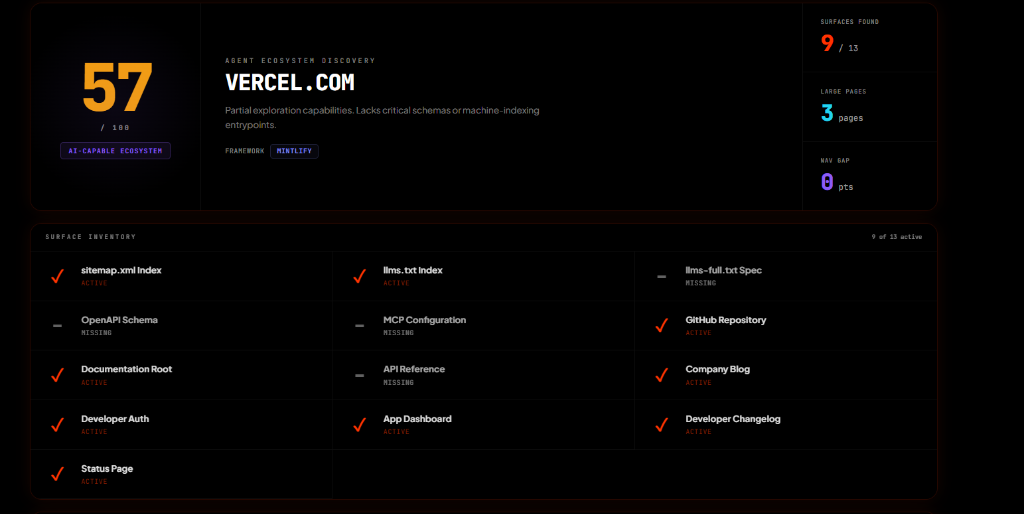
Witness how autonomous coding agents navigate, ingest context, authenticate, and execute tools. Toggle between real-time Flight Simulation telemetry and the 119-check ARS 3.0 protocol matrix.
Agents crawl SPA HTML shells, encounter soft-200 canaries, and burn 38,400 tokens ($0.115/task) with a 4.2s latency.
Clean MCP & llms.txt entrypoints reduce consumption to 1,240 tokens ($0.0037/task), resolving tasks in 340ms without retries.
glintbase simulate . --agent claude-codeDeep Audit is an expert-led engagement that delivers a complete understanding of your software's agent readiness — and a precise roadmap to improve it.
Multi-Agent Flight Simulation
Empirical multi-turn tracing across Claude Code (200k), Cursor (128k), and Perplexity (zero-JS) personas.
E2B Runtime Sandboxed Execution
Executing documentation code blocks and API calls inside isolated Linux micro-VMs to verify parameter truth.
White-Box Offline AST Inspection
Direct AST code analysis of Next.js middleware, HTTP headers (Vary: Accept), and API handlers from source.
Counterfactual 'What-If' Proof Card
In-memory ArsSandbox retests proving exact token reduction (-90%+) and latency savings before disk writes.
Anti-SPA 404 Canary Leak Prevention
Active detection and remediation of soft-200 HTML shells that induce severe agent hallucination loops.
Executive Governance & Compliance Report
Board-ready audit encompassing OWASP LLM Top 10, ISO/IEC 42001, and WorkOS auth.md specification parity.
The core of what Glintbase is building is open source. We believe agent readiness infrastructure should be inspectable, forkable, and community-owned.
Glintbase Agent Harness (ARS 3.0). Autonomous auditor with 119 checks, Multi-Agent Flight Simulator, AST code doctor, and CI drift shield.
Open-source scanner engine with E2B isolated runtime sandboxing, 3D knowledge graph, and deep crawl extraction.
Model Context Protocol server with 17 production tools and 9 bundled skills for Claude Code, Cursor, Windsurf, and Antigravity.
GitHub Action PR Drift Shield. Automatically gates pull requests on ARS thresholds with automated PR Markdown scorecard comments.
Software is increasingly operating in a world where its primary consumers are not humans.
AI agents — systems that retrieve, reason, execute, and infer — are becoming active participants in every software workflow. They read documentation. They call APIs. They follow onboarding flows. They use CLIs, SDKs, and support surfaces.
This is happening now. And virtually no software was designed for it.
The gap between what software exposes and what AI agents need to operate it effectively is one of the most consequential infrastructure problems of the next decade.
Glintbase exists to close that gap.
We are building the intelligence layer that enables software to become understandable, navigable, and operable by the machines that increasingly depend on it.
This is not a documentation product. It is not an AI writing assistant. It is infrastructure — the kind that sits underneath, does its work quietly, and becomes foundational.
The companies that build this layer into their software now will have a compounding structural advantage as the agentic era develops.
We are building that layer.
Run a free scan on any URL. Or join the waitlist to be part of what we build next.